Desert Online General Trading LLC
Dubai, United Arab Emirates
Desert Online General Trading LLC
Dubai, United Arab Emirates
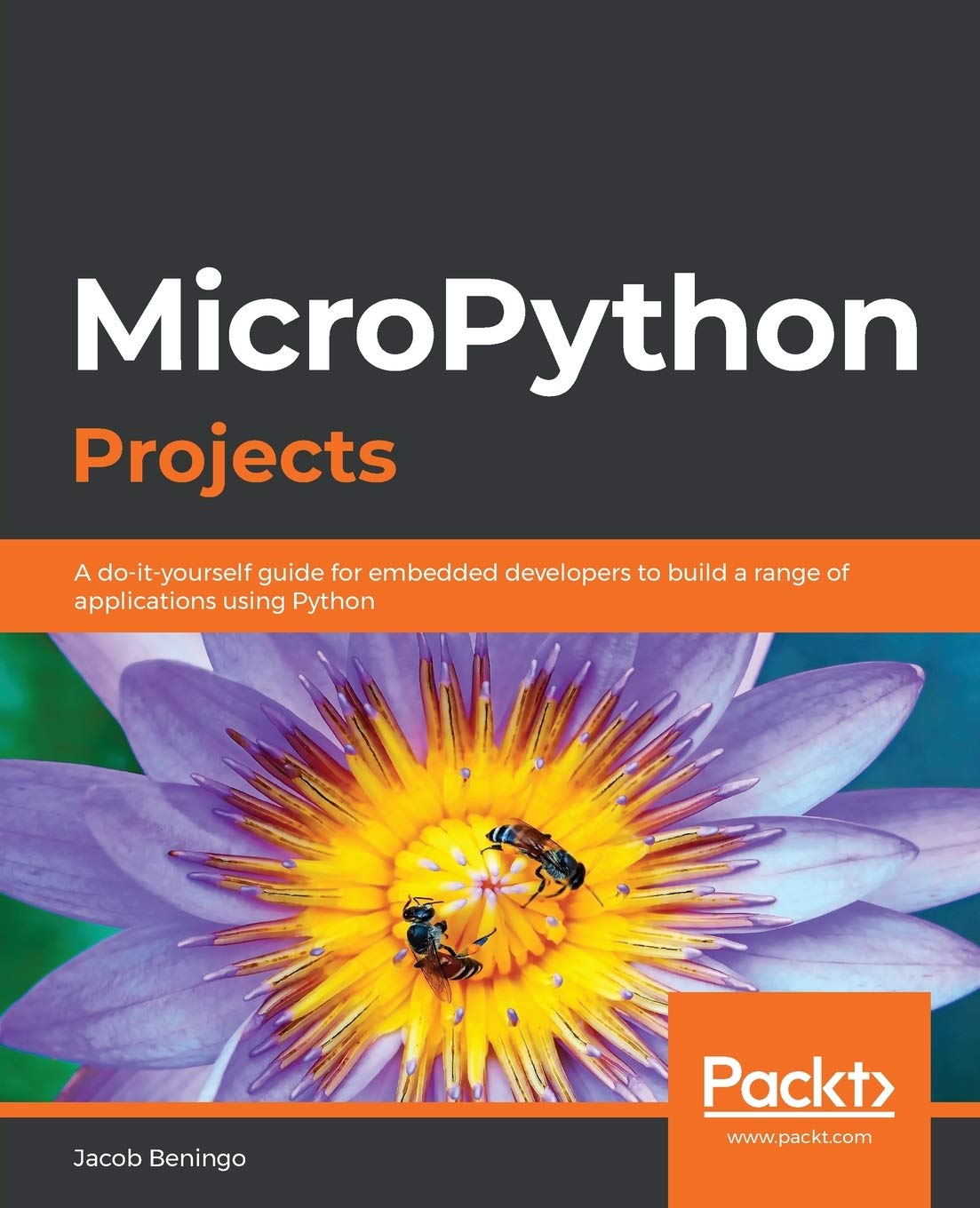
Full description not available
C**N
This is a good book and it contains some very useful information.
I read this book because I use Micropython for personal projects. As such, I am always looking for good books on the subject of Micropython.If you want to make small changes or additions to the Python core, this book will tell you how to do that.If you use the ESP32 controller, you will want to read the section on setting up a project using the ESP32 wireless module...
C**N
A great source of programing patterns.
The book is a great source of pattern ideas for working with Micropython. The author utilizes the PyBoard platform. As the libraries for this class of microprocessors are different for the different processors, there was little to be gained for my work with ESP32's.I'm not sure that there is a solution to the above. Just don't expect example code that will port well to other microprocessors (i.e. the ESP32 does PWM so there is no need to reinvent that wheel.)
C**D
A Fantastic Book for the Right Audience
Let’s commence with the full disclosure “weasel words” (remember that eagles may soar, but weasels rarely get sucked into jet engines). First, I’m a friend of the author; second, the publisher gave me a free copy of the book to peruse, ponder, and review.OK, so I’ll start by saying that this book is not for everyone. It’s intended for a specific audience and for that audience it’s a fantastic book, but it’s not intended for beginners.The high-level blurb for the book says: “A basic understanding of electronics and Python is required while some MicroPython experience will be helpful.” When you start reading the book, it becomes a little more specific by saying: “This book assumes that the reader has a basic understanding of Python and that they have at least built a few embedded systems projects previously.”I think the key point here is the fact that the book is targeting readers who have already created a couple of embedded systems, so they understand concepts like hardware abstraction layers (HALs) and they are familiar with using GitHub and suchlike.I’m a hardware design engineer by trade. I can read and write software (predominantly C with a hint of a sniff of Python), but you wouldn’t want to use my hobbyist-level code for anything serious. Also, I’ve found it difficult in the past to meander my way around GitHub and download and install libraries and make sense of other peoples’ implementations, which is something professional embedded systems developers appear to have no problems with at all.So, assuming that you already have a clue what you are doing with regard to microcontroller development boards and embedded systems, and aren’t afraid when you hear the term “Python,” then this book provides an awesome introduction to MicroPython, which is an efficient and lean implementation of the Python 3 programming language optimized to run on microcontrollers.The book starts by setting the scene -- talking about the advantages and disadvantages of languages like C/C++ and Python and MicroPython. Next, we look at different ways to manage real-time tasks in MicroPython, using blinking a couple of unicolor LEDs as examples. This leads us into creating a simple application to read a pushbutton and use it to cycle through a series of colors on a tricolor (RGB) LED.From here, the author keeps building things up layer-by-layer, developing an application test harness, customizing the MicroPython Kernel start-up-code for your own boards, and creating a visualizer tool to display sensor data. By the end of the book, we are using MicroPython, computer vision, and machine learning (ML) to build an object detection system using the OpenMV Camera.I know many embedded systems developers who are devoted to C, but although C is incredibly powerful, it also provides you with a lot of ways to mess up (I found most of them on my own). I also know developers who started off by dipping their toes in the MicroPython waters and who subsequently became ardent users, especially for things like sensor evaluation and rapid prototyping.If you are an embedded systems developer, then the worst-case scenario is that reading this book could give you “another string to your bow” -- but beware, because you may find yourself sliding down the slippery slope to becoming a MicroPython advocate.
B**T
The chapter on managing real-time tasks alone is worth the admission price
This is one of the most interesting books I've discovered for MicroPython. It's clearly written, the examples are comprehensive, and most important of all—I gained new insights and knowledge. The author has created a series of very useful projects and a design methodology that I am adopting for my own needs. The chapter on managing real-time tasks alone is worth the admission price.I'm an electrical engineer and I've been programming embedded systems for about 40 years. I've used many different languages, debuggers, middleware, and IDEs. A couple of years ago, I discovered MicroPython that runs on a STM32F405 MCU. Since then, I've developed several products from automotive to industrial applications that utilize the MicroPython environment. And unless I really need to program in C, I'm sticking with MicroPython. It's that good.One thing I must mention first. This is not a book for beginners. It helps if you have some Python experience, but you should really have some hands-on experience with MicroPython. There are excellent sources on the web and other books such as Programming with MicroPython: Embedded Programming with Microcontrollers and Python by Nicholas Tollervey. But when you're ready to take the next step, then MicroPython Projects should be on your list of must reads.The first chapter makes the case for MicroPython. Although the author makes it clear of the advantages of using MicroPython, I would go even further and make the bold statement that MicroPython will become the dominant embedded programming language in the foreseeable future. My main justification is that Python is the world most popular computer language. Even embedded projects that utilize the Raspberry Pi use Python. Furthermore, those knowledgeable in embedded C are becoming a scarce resource, especially in the U.S.The second chapter is my favorite. It's about managing real time tasks. Yes, it's possible with MicroPython which makes it different from regular Python. The author explains standard methods familiar with RTOS programmers. This includes round-robin scheduling, periodic scheduling using timers, event-driven scheduling, cooperative scheduling, and even using the nascent (and too early to use) MicroPython thread mechanism. Of these, the “asyncio” library has the ability to do cooperative multitasking,and a simple example is provided. Brilliant. My only comment is that not all versions of MicroPython (e.g. CircuitPython) can use these techniques and perhaps this could have been pointed out.The third chapter goes into details on hooking up some hardware to a PyBoard and writing the drivers to support it. The author details the design methodology including flow diagrams, building a series of “test cases,” and creating class objects to drive the hardware. My only comment is that one of the libraries was written as a class object, where as the second example is not. However, a glance at the git repository where the example code is available shows everything tied together as class libraries and invoked with a “main.py” module.The fourth chapter introduces the concept of “test harnesses.” These are used to test the MicroPython modules and application code. A simple example is used to convey the general idea.The fifth chapter is also very useful. It explains how you can customize the MicroPython kernel. This is important if you need to port to another MCU or if you want to develop custom libraries that can be included in the kernel. I've had to do this in the past to overcome some MCU peripheral limitations and functionality, as well as “freezing” libraries into the kernel as I started to run out of SRAM. Although the procedures for doing the modifications can be found on the internet, this is the first time I've seen it clearly presented in a book form.Chapter Six discusses ways to visualize data which is very useful during code development such as plotting data from a sensor in real-time (or near real-time) on your PC. In a typical C development, this is a bit of a challenge. The REPL prompt of MicroPython (and PC Python) is a very powerful feature which can be leveraged to send data to a PC over USB and displaying the data graphically using the Python mathplotlib (or Tkinter) libraries.To round out the rest of the book, Chapter Seven goes through a gesture recognizer that uses IR emitters and detectors, Chapter Eight explains how to use Android and the web to communicate with a ESP32 MicroPython board, Chapter Nine has examples for machine learning, and Chapter Ten provides a glimpse into the near future of MicroPython.So what's not to like about MicroPython Projects? I found the mix of examples using class objects and regular code to cause some temporary confusion. But my main complaint is the quality of some of the pictures and diagrams. For $40, I would expect higher print quality. But that is really the fault of the publisher.Although this book has a lot of useful information, more is needed. By it's nature, MicroPython can be slow and memory hungry. But it doesn't have to be as there are many ways to speed it up and optimize memory. Perhaps this can be covered in a second volume.All in all, an excellent read and I highly recommend it.
B**.
Pretty Bad
Don't waste your money. Luckily Amazon makes it easy to return stuff!
Trustpilot
1 month ago
2 weeks ago
2 days ago
1 month ago